
Motion that carries the story
Cinematic motion components
This collection treats animation as a narrative tool. Depth, hover, scroll, and state transitions help people understand the product while static, reduced-motion, and low-capability paths preserve the same information and actions.
Why this set works
A stronger implementation baseline.
Animation reinforces real content hierarchy and product state
Hover and pointer effects retain complete keyboard equivalents
Reduced-motion and media fallbacks remain first-class experiences
Working source
Preview, customize, and download.
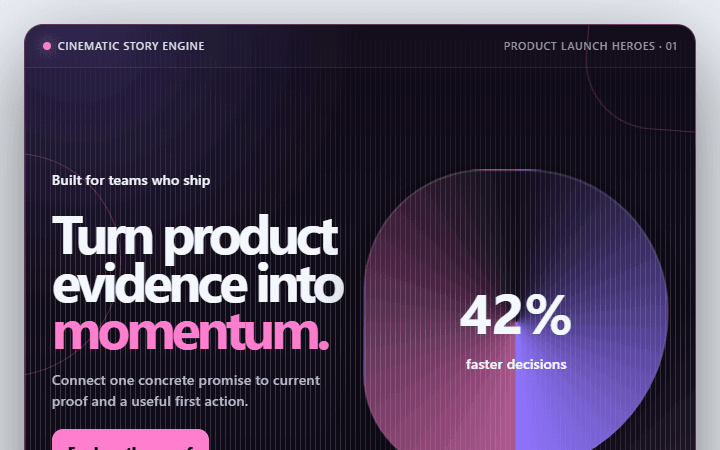
Outcome Hero · Product launch heroes
Leads with one concrete result, audience, and next action for new product, feature, and category launches.
Open component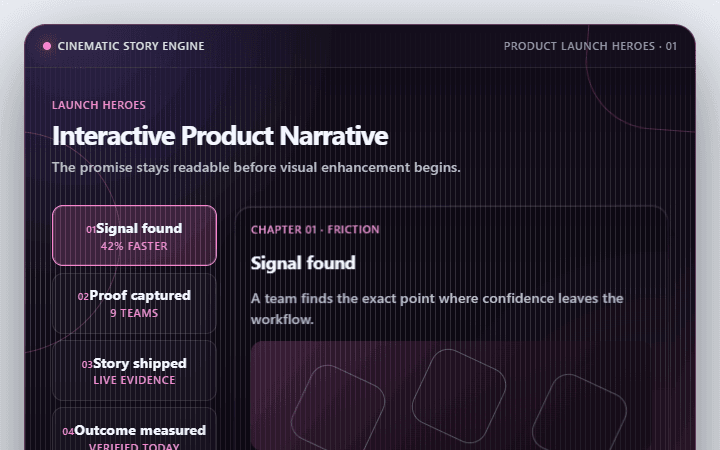
Interactive Product Narrative · Product launch heroes
Lets visitors explore a workflow rather than watch a decorative product mockup for new product, feature, and category launches.
Open component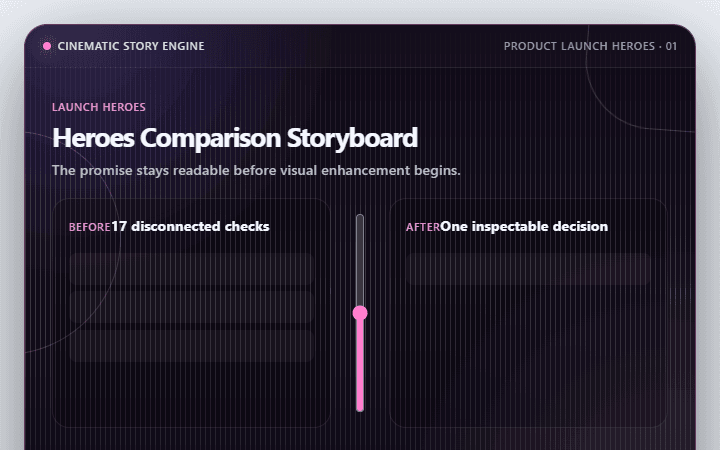
Comparison Storyboard · Product launch heroes
Explains the practical difference between approaches without a vague feature checklist for new product, feature, and category launches.
Open component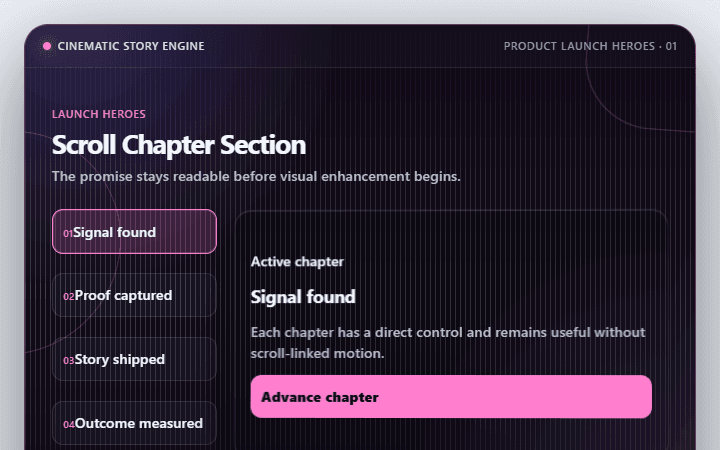
Scroll Chapter Section · Product launch heroes
Presents a long product story in chapters without scroll-jacking for new product, feature, and category launches.
Open component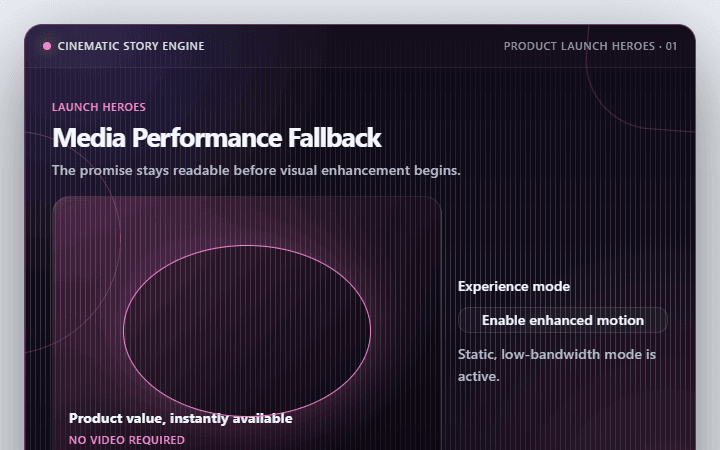
Media Performance Fallback · Product launch heroes
Keeps the story useful when rich media is slow, blocked, or reduced for new product, feature, and category launches.
Open component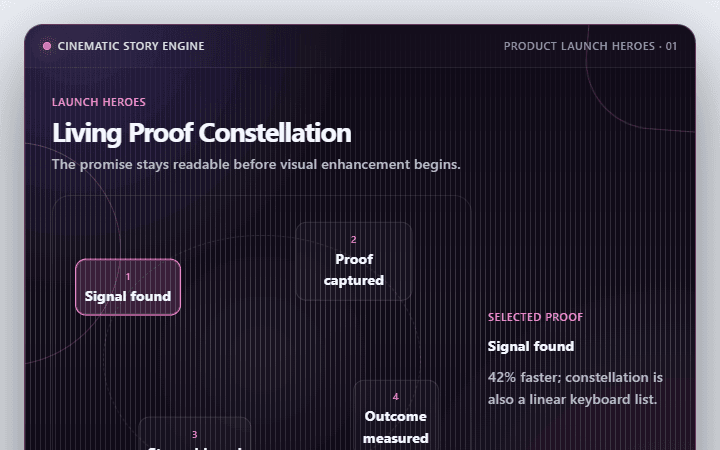
Living Proof Constellation · Product launch heroes
Connects customer outcomes, product moments, and evidence into an explorable signature story for new product, feature, and category launches.
Open componentBefore shipping
Implementation checklist.
Use these checks after adapting the components to your content and application state.
- 01
Tie every motion sequence to a content or state change.
- 02
Keep controls and text useful while animation is paused or unavailable.
- 03
Avoid layout-triggering animation on large or repeated elements.
- 04
Test reduced motion, touch input, and mid-range mobile hardware.
Implementation guidance